


AI Voice
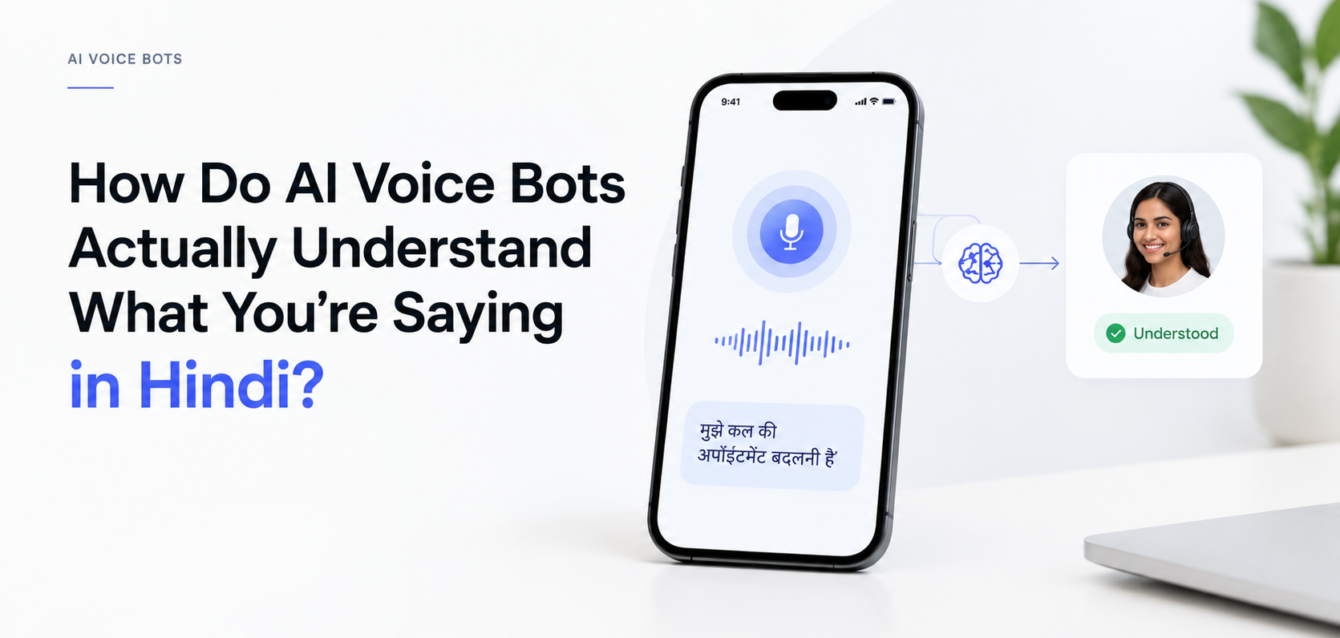
AI Voice You say something in Hindi. The bot understands — and replies in under a second. Here’s the surprisingly complex chain of technology that makes that possible. And why it’s much harder than English.
If you’ve ever spoken to an AI voice bot in Hindi and thought, “Wait… how did that thing actually understand me?” you’re not alone.
For most people, voice AI feels like magic. You say something like:
And somehow, within a second, the system understands what you meant and replies.
But under the hood, there’s no magic. Just a surprisingly fast chain of technologies working together.
And in India, that job is much harder than most people realise. Because understanding spoken Hindi isn’t the same as understanding spoken English. Not even close.
Let’s break down what’s actually happening when you talk to a Hindi AI voice bot.
Step 1: The AI has to hear you properly
The first challenge sounds simple. You speak. The machine listens. Done?
Not really.
A machine doesn’t “hear” language the way humans do. It hears raw audio signals. Just sound waves. Its first job is converting those sound waves into text. This process is called speech-to-text or automatic speech recognition (ASR).
Easy in theory. Messy in real life. Because Indian conversations are chaos — and that’s not criticism. That’s reality.
That’s normal Indian speech. And the system has to get it right — fast.
Add to that the typical background noise of an Indian environment:
Most speech recognition systems trained primarily on clean English audio struggle badly in this environment.
Why Hindi speech recognition is harder than English
English voice recognition has had a massive head start. More datasets. More commercial use. More clean training audio. More standardisation.
Hindi introduces very different challenges.
Code-switching
This is the biggest one. People don’t speak “pure Hindi” consistently. They mix constantly.
Humans don’t even notice this happening. AI systems absolutely have to handle it — or they fail on most real Indian calls.
Accent variation
Hindi in Delhi sounds different from Hindi in Lucknow. Mumbai rhythm differs. Jaipur phrasing differs. Then you get pronunciation variations influenced by regional languages — someone from Hyderabad speaking Hindi may sound very different from someone in Chandigarh. Humans adapt instantly. Machines need explicit training for each variation.
Informal speech
People don’t speak to bots the way product teams expect. Nobody says: “I would like information regarding your home loan offerings.”
Machines need to understand intent, not textbook phrasing. That’s a completely different engineering problem.
Step 2: Understanding what you actually meant
Converting speech into text is only half the problem. Because recognising words doesn’t mean understanding meaning.
This is where natural language understanding (NLU) comes in. Think of it as the interpretation layer. It’s not asking: What exact words were spoken? It’s asking: What does this person actually want?
That sounds obvious. It’s not. Because language is messy.
That’s why modern systems don’t rely on simple keyword matching.
Keyword-triggered flows
Pattern recognition over phrasing
Step 3: Context matters more than the sentence
This is where people misunderstand voice AI. The system doesn’t only process the latest sentence. It tracks conversation flow.
User: “Mujhe ek car loan chahiye.” → Bot: “What budget are you considering?” → User: “Around 8 lakh.” That second sentence means nothing by itself — but with context, it’s everything.
This is conversational memory . Without it, AI becomes unusable very quickly. Every message would require the user to re-explain everything from scratch — and they won’t. They’ll just hang up.
Step 4: Generating the response
Now the system knows what you said, what you meant, and what context exists. Next question: what should it say back?
Simple systems use scripted flows. Intent = loan enquiry → ask budget → ask city → ask employment type. This works fine for narrow, predictable workflows. It breaks the moment users behave unpredictably — which is most of the time.
Modern conversational systems generate responses dynamically. That’s why they feel less robotic. Instead of:
“Please choose option 1, 2 or 3.”
You get:
“Sure. Are you looking for a personal loan or home loan?”
Much more natural. But harder to engineer safely — because generated responses must still stay accurate and within scope. That balance is one of the harder problems in production voice AI.
Step 5: Turning text back into speech
Now the AI has its response. But text isn’t enough. A voice bot has to speak . That means text-to-speech (TTS).
This sounds easy until you’ve heard bad Hindi voice systems. Most people have.
Robotic pacing — reading words rather than speaking naturally, with unnatural pauses between phrases.
Pronunciation inconsistency — “EMI” spoken awkwardly, English acronyms mispronounced in a Hindi voice stream.
No emotional register — Hindi carries different formality levels. “Aap” vs “tum” vs “tu” signals different relationships. TTS often ignores this.
Code-switch transitions — switching between Hindi and English mid-sentence without the seam sounding jarring is genuinely hard to get right.
Step 6: Doing all this fast enough
Now here’s the wild part. Everything above has to happen almost instantly.
If this takes too long, the experience feels broken. Even if the answer is technically correct. That’s why latency matters so much in voice AI — humans expect conversational rhythm. Too much silence feels unnatural. And once the interaction feels robotic, trust drops fast.
So is AI actually understanding Hindi?
Sort of. And the distinction matters.
AI does not “understand” Hindi the way humans understand language. It does not think. It does not interpret emotion like a human.
It recognises patterns incredibly fast.
That pattern recognition is sophisticated enough to feel like understanding. And when engineered well, for the user, that distinction barely matters. What matters is whether the system responds correctly and naturally.
Why this matters in India specifically
India is one of the hardest environments for voice AI. Not because the technology is weak. Because the linguistic reality is messy.
Multiple languages. Mixed speech. Regional accents. Noisy environments. Code-switching every few words. A voice bot that works well in a clean English demo can collapse completely in an actual Indian business environment.
That’s why Indic voice AI is a real engineering problem, not just a translation problem. You can’t take an English voice model and localise it. You need to build for the actual conditions of Indian conversations from the ground up. And honestly, that’s what makes it interesting. Because when it works well, it feels less like software. And more like conversation.