


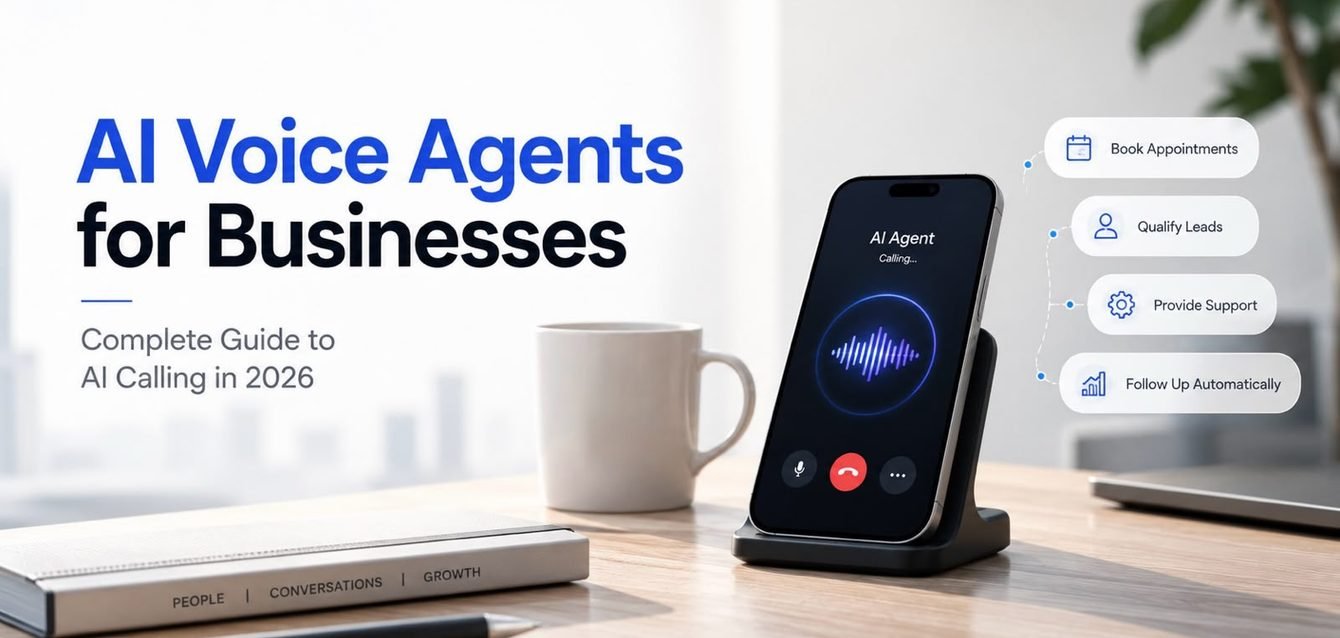
If your team is still manually dialing leads, chasing missed calls, or losing customers to slow response times, you’re not alone — and you’re leaving revenue on the table. AI Voice Agents have moved from experimental tech to a mainstream business tool in 2026, helping companies in Hyderabad and across India handle calls, qualify leads, and support customers around the clock, without adding headcount.
This guide breaks down everything you need to know about AI Voice Agents: how they work, why they matter for growing businesses, real-world use cases, and how to choose the right AI calling partner in 2026. Whether you run a real estate firm in Gachibowli, a clinic in Banjara Hills, or a D2C brand shipping across India, this guide will help you understand where AI calling fits into your operations.
What Are AI Voice Agents?
AI Voice Agents are software-based systems that can make and receive phone calls, hold natural, human-like conversations, and complete tasks — all without a human on the other end of the line. Unlike old-school Interactive Voice Response (IVR) systems that force customers to “press 1 for sales,” modern AI voice agents use large language models (LLMs), speech recognition, and text-to-speech technology to understand context, answer questions, and take real action.
In simple terms, an AI voice agent can:
- Answer inbound calls instantly, 24/7
- Make outbound calls to qualify leads or send reminders
- Understand natural speech in multiple languages and accents
- Pull and update information from your CRM in real time
- Hand off complex conversations to a human agent when needed
This is fundamentally different from a chatbot. A voice AI agent listens, understands intent, and responds conversationally — closer to talking to a well-trained employee than navigating a phone menu.
How AI Calling Technology Has Evolved
Early voice bots of the 2010s were rigid and scripted. By 2026, AI voice agents combine three major technology layers:
- Speech-to-text (STT): Converts spoken words into text in real time, even with regional accents.
- Conversational AI / LLM reasoning: Understands intent, context, and nuance — not just keywords.
- Text-to-speech (TTS): Generates natural, human-sounding voice responses in multiple languages.
The result is a voice agent that feels less like a machine and more like a well-briefed teammate who never takes a day off.
Why Businesses Are Switching to AI Voice Agents in 2026
Customer expectations have changed. People want instant answers — not hold music, not “our office hours are 9 to 6,” and not a missed call that never gets returned. Here’s why businesses across industries are adopting AI calling software this year.
1. Round-the-Clock Availability
A missed call is often a missed sale. AI voice agents answer every call, every time — at 2 PM or 2 AM — so leads and customers never hit a dead end.
2. Consistent, Scalable Conversations
Human agents have good days and bad days. An AI voice agent delivers the same quality, tone, and accuracy on call number 1 and call number 10,000.
3. Lower Cost Per Interaction
Hiring, training, and retaining call center staff is expensive — especially with high attrition in voice process roles. AI voice agents reduce dependency on large calling teams while handling repetitive, high-volume conversations.
4. Faster Lead Response Times
Studies have long shown that leads contacted within the first five minutes convert significantly better than those contacted an hour later. AI voice agents can call back a lead the moment they submit a form — no waiting for a rep to be free.
5. Multilingual, Localized Conversations
For businesses in Hyderabad and across India, language matters. Many AI voice platforms — including AIVRY — support Telugu, Hindi, Tamil, English, and other regional languages, so customers can speak naturally instead of struggling through English-only scripts.
How AI Voice Agents Work: A Step-by-Step Breakdown
Understanding the mechanics helps you evaluate the right solution for your business. Here’s how a typical AI voice agent handles a call from start to finish:
Step 1: Call Trigger
A call is triggered either inbound (a customer dials your business number) or outbound (the AI dials a lead or customer based on a workflow — such as a new form submission or an appointment reminder).
Step 2: Real-Time Understanding
The AI voice agent transcribes and interprets what the caller says in real time, identifying intent — whether that’s booking an appointment, asking about pricing, or requesting a refund.
Step 3: Contextual, Natural Response
Using conversational AI trained on your business data, FAQs, and workflows, the agent responds naturally—not with rigid scripts, but with context-aware answers that adjust based on what the caller says.
Step 4: Action and Integration
This is where AI voice agents go beyond chatbots. They connect to your CRM, scheduling tools, or helpdesk to actually complete tasks: booking a slot, updating a lead status, checking order details, or logging a support ticket.
Step 5: Human Handoff (When Needed)
For complex, sensitive, or high-value conversations, a well-built AI voice agent recognizes its limits and transfers the call to a human—along with full conversation context —so the customer never has to repeat themselves.
Key Use Cases: AI Voice Agents Across Industries
AI calling isn’t a one-size-fits-all tool. The best implementations are tailored to specific industry workflows. Here’s how different sectors are using AI voice agents in 2026.
Real Estate
- Qualifying inbound property inquiries by budget and location
- Booking site visits automatically into agents’ calendars
- Pre-screening loan eligibility before human follow-up
Healthcare and Clinics
- Automated appointment booking and rescheduling
- Post-op or post-consultation follow-up calls
- Insurance and billing query triage before escalation
Education Institutions
- Handling admissions inquiries during high-volume seasons
- Parent communication for fee reminders and updates
- Answering repetitive FAQs about courses and eligibility
BFSI and Fintech
- Conversational KYC verification calls
- Fraud alert escalation calls
- Answering loan and product FAQs at scale
D2C and Retail Brands
- Order tracking and delivery status calls
- Returns and exchange handling
- Proactive outbound calls for cart recovery or upsells
Hospitality and Travel
- Reservation confirmations and modifications
- AI concierge-style guest queries
- Automated upsell sequences (room upgrades, add-ons)
Logistics and Fleet Operations
- Driver dispatch coordination calls
- Delivery failure (NDR) resolution calls
- Real-time fleet status check-ins
Example: A mid-sized real estate firm in Hyderabad using an AI voice agent for lead qualification can automatically call every website inquiry within seconds, ask budget and location questions, and route only “hot” leads to human agents—cutting wasted sales time by a significant margin while ensuring no lead goes uncontacted.
AI Voice Agents vs. Traditional Call Centers vs. Chatbots
| Factor | Traditional Call Center | Text Chatbot | AI Voice Agent |
|---|---|---|---|
| Availability | Business hours (mostly) | 24/7 | 24/7 |
| Channel | Phone only | Text/chat only | Voice (phone calls) |
| Scalability | Limited by staff | High | High |
| Consistency | Varies by agent | Consistent | Consistent |
| Personal feel | High (human) | Low | High (natural voice) |
| Cost at scale | High | Low-medium | Medium (lower than call center) |
| Multilingual support | Depends on hiring | Depends on setup | Built-in with the right platform |
Voice remains the preferred communication channel for many customers, especially for urgent queries, elderly demographics, or regions where typing in English isn’t comfortable — which is exactly why AI calling agents are gaining ground over chat-only automation.
What to Look for in an AI Voice Agent Platform
Not all AI calling tools are built the same. When evaluating a provider for your business, look for these essentials:
1. Natural, Low-Latency Conversation
If there’s a noticeable delay between what the caller says and the AI’s response, the experience feels robotic and frustrating. Look for platforms built for real-time, low-latency conversation.
2. CRM and Workflow Integration
An AI voice agent that can’t sync with your CRM, ERP, or helpdesk is just a fancy answering machine. The real value comes from closing the loop — updating records, booking calendars, and triggering next steps automatically.
3. Multilingual and Regional Language Support
For businesses operating in Hyderabad and across India, the ability to converse fluently in Telugu, Hindi, and other regional languages — not just English — is critical for genuine customer connection.
4. Industry-Specific Templates
Generic AI agents require months of customization. Platforms with pre-built, industry-tuned templates (for real estate, healthcare, BFSI, recruitment, and more) get you live faster.
5. Fallback and Human Handoff Logic
No AI system should be left to “wing it” on edge cases. A reliable platform includes confidence scoring and seamless handoff to a human agent with full context.
6. Security and Compliance
Since voice agents handle sensitive customer data, look for providers with strong information security practices — such as ISO 27001 certification, data encryption, role-based access, and clear data ownership policies.
7. Speed to Deployment
Traditional enterprise AI projects can take months of discovery and development. Look for providers that can get a working agent live in days or weeks — not quarters.
How AIVRY Approaches AI Voice Agents
At AIVRY, we built our AI voice and conversation products around a simple idea: your business shouldn’t stop when your team does. Our voice and chat agent, Nio, handles calls, WhatsApp, and web conversations so leads get answered instantly and workflows keep moving — even outside business hours.
Here’s what sets AIVRY’s approach apart:
- Fast deployment: A median of 11 days from kickoff to a live, working agent, using 40+ industry-tuned templates instead of starting from scratch.
- Real integrations: Nio connects to your existing CRM, ERP, and helpdesk via APIs and webhooks, so conversations turn into actual actions — not just transcripts.
- Multilingual by design: Conversations in Hindi, Tamil, English, and more than a dozen other languages, so customers in Hyderabad and beyond can speak naturally.
- Built-in fallback logic: Every agent includes intent confidence scoring and live handoff to your human team, with full conversation history attached — so nothing falls through the cracks.
- Security-first foundation: AIVRY operates under ISO 27001 information security and ISO 9001 quality management standards, with support for data residency in India and signed data processing agreements for enterprise customers.
- Weekly optimization: Every conversation feeds an analytics layer that surfaces drop-offs and intent gaps, so your agent gets smarter month over month.
If you’re a growth-stage business in real estate, healthcare, BFSI, education, D2C retail, hospitality, or logistics, AIVRY’s voice agents are built to plug into how your operations actually work — not force you into a generic template.
Common Mistakes Businesses Make When Adopting AI Calling
Learning from others’ missteps can save you time and budget. Here are frequent pitfalls to avoid:
- Treating AI voice agents like a chatbot with a voice. Voice conversations need different pacing, tone, and interruption-handling than text.
- Skipping the human handoff design. Customers get frustrated fast if there’s no clear path to a human for complex issues.
- Ignoring regional language needs. English-only agents alienate a large share of Indian customers who prefer speaking in their native language.
- Not integrating with existing systems. An AI agent that can’t update your CRM creates more manual work, not less.
- Expecting zero-touch setup. Even the best platforms need your team to define workflows, FAQs, and edge cases upfront for the best results.
Actionable Tips: Getting Started with AI Voice Agents
If you’re ready to explore AI calling for your business, here’s a practical starting checklist:
- Map your top 3 customer journeys (e.g., new lead inquiry, appointment booking, support query) before choosing a platform.
- Identify your highest call-volume pain point — is it missed leads, slow response times, or repetitive FAQs eating up staff time?
- Shortlist providers with industry-relevant templates rather than fully custom builds to reduce time-to-launch.
- Insist on a pilot or demo call using your actual business scenarios before committing.
- Set clear escalation rules for when the AI should hand off to a human.
- Review analytics weekly in the first month to catch gaps in intent recognition early.
The Future of AI Voice Agents Beyond 2026
AI calling technology is moving quickly toward even more natural, proactive, and emotionally aware conversations. Expect to see:
- Deeper personalization, where agents recall past conversations and tailor responses accordingly
- Proactive outreach, with AI agents initiating calls based on behavioral triggers, not just scheduled workflows
- Tighter integration with omnichannel journeys, so a customer can start on WhatsApp and finish on a call without repeating themselves
- Improved emotional intelligence, with agents detecting frustration or urgency and adjusting tone or escalating appropriately
Businesses that adopt AI voice agents early are positioning themselves to offer faster, more consistent customer experiences — a real competitive advantage as customer patience for slow response times continues to shrink.
Frequently Asked Questions (FAQs)
1. What is an AI Voice Agent? An AI Voice Agent is a software system that uses conversational AI, speech recognition, and text-to-speech technology to make or receive phone calls and hold natural, human-like conversations — without a human operator on the call.
2. How is an AI Voice Agent different from a regular IVR system? Traditional IVR systems rely on rigid menus (“press 1 for sales”). AI Voice Agents understand natural spoken language, interpret intent, and respond conversationally, making the experience feel far more human and efficient.
3. Can AI Voice Agents speak Telugu, Hindi, or other Indian languages? Yes. Many modern AI voice platforms, including AIVRY, support multiple Indian languages such as Telugu, Hindi, and Tamil, in addition to English, so businesses in Hyderabad and across India can serve customers in their preferred language.
4. Are AI Voice Agents only useful for large enterprises? No. AI voice agents are increasingly used by growth-stage businesses and small teams, since they reduce the need to hire large calling teams while still delivering 24/7 coverage.
5. Will an AI Voice Agent replace my human sales or support team? Not entirely. The goal is to handle repetitive, high-volume conversations automatically, while routing complex or high-value interactions to human agents — freeing your team to focus on what actually needs a human touch.
6. How long does it take to set up an AI Voice Agent for my business? Deployment time varies by provider, but modern platforms using pre-built, industry-tuned templates can get a working agent live in as little as 1–2 weeks, compared to months for fully custom builds.
7. Is it safe to let an AI Voice Agent handle sensitive customer data? It depends on the provider’s security practices. Look for platforms with strong data protection standards, such as ISO 27001 certification, encryption, role-based access controls, and clear data ownership policies before handling sensitive conversations.
8. Which industries benefit most from AI calling technology? Real estate, healthcare, BFSI and fintech, education, D2C retail, hospitality, and logistics are among the industries seeing the fastest adoption, largely due to high call volumes and repetitive, structured conversation needs.
9. Can AI Voice Agents integrate with my existing CRM or helpdesk? Yes, most modern platforms integrate with CRM, ERP, and helpdesk systems via APIs and webhooks, allowing the AI agent to update records, book appointments, and trigger workflows in real time.
10. How much does an AI Voice Agent cost compared to hiring call center staff? Costs vary by provider and call volume, but AI voice agents generally offer a lower cost per interaction than scaling a human calling team, especially for high-volume, repetitive conversations. It’s best to request a custom quote based on your call volume and use case.
Ready to Automate Your Business Calls?
AI Voice Agents are no longer a “nice to have” — they’re becoming the standard for businesses that want to respond faster, serve customers better, and scale without ballooning headcount. Whether you’re in real estate, healthcare, retail, or hospitality, an AI calling agent tailored to your workflow can start capturing missed opportunities within days.
Ready to see it in action? Book a demo with AIVRY today and discover how Nio can handle your calls, qualify your leads, and keep your business moving — 24/7, in the languages your customers actually speak.